Article in press
A new article, “Quantifying infants’ everyday restrained experiences in the home using wearable inertial sensors” was accepted at Behavior Research Methods. The article was authored by Hanzhi Wang, Hailey Rousey, and John Franchak. This was a fully reproducible manuscript, and the data and code required to compile the manuscript are available on OSF. A preprint is available here.
Abstract
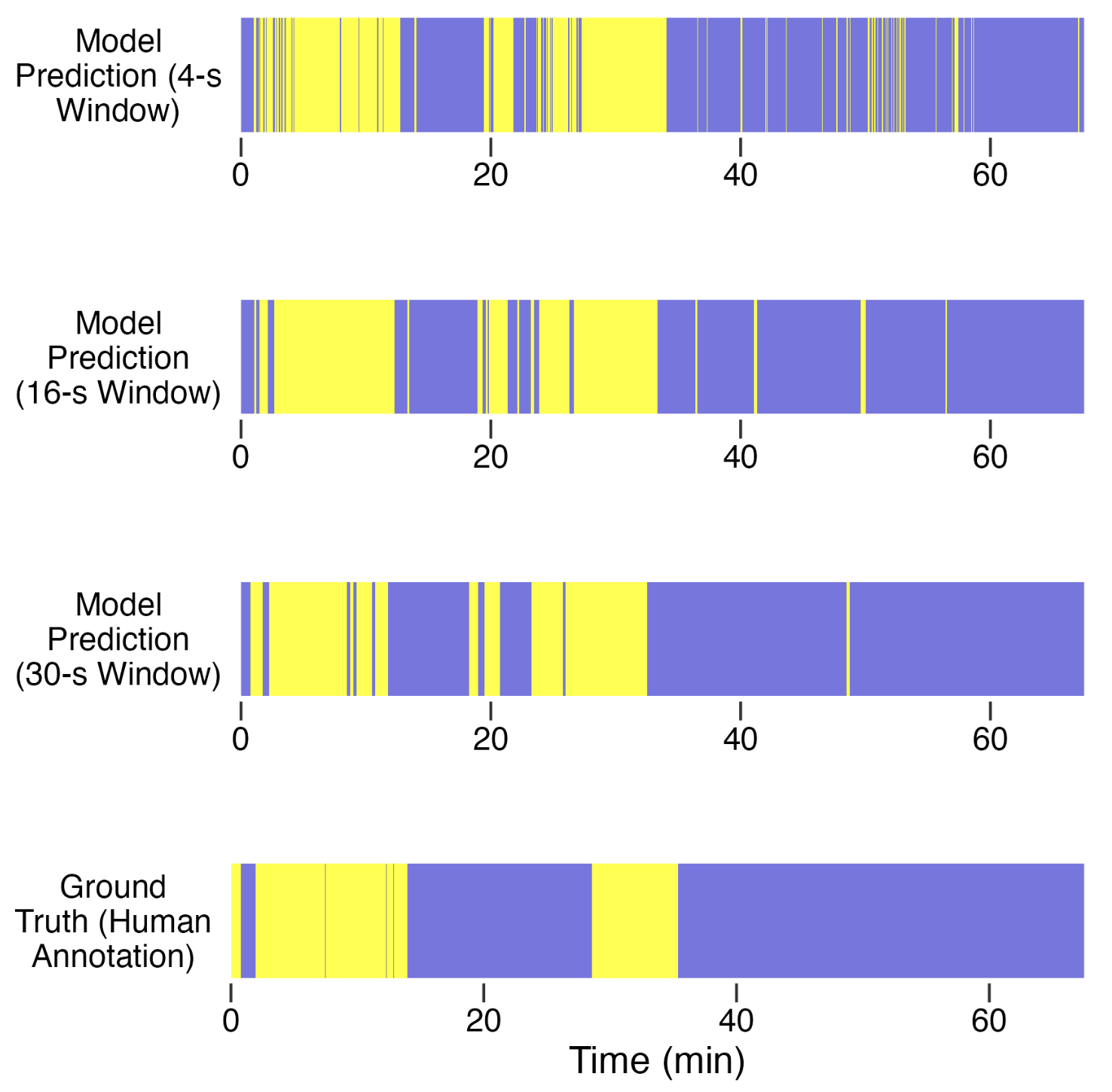
Physical restraint—including being held, carried, and restrained in devices—is a common feature of infants’ everyday lives. However, previous survey-based and video-based methods cannot simultaneously provide continuous, full-day accounts of infant restrained experiences. This study developed and validated a machine learning model to quantify infants’ restrained time moment- to-moment across the full day in the home environment using wearable sensor data. We used a dataset that includes 146 home-visit sessions from 66 infants, with 30 younger infants aged 4-7 months, and 36 older infants aged 11-14 months. We annotated infants’ restrained states in the first 1.5-hour video recordings of each session as ground truth labels. The supervised machine-learning model achieved high accuracy (89%) and substantial kappa agreement (κ = .73) compared with human-coded ground truth. The model presented a slight bias towards overestimating unrestrained periods compared to restrained periods, but the bias was mitigated when we used a longer data-aggregating window length. The model also showed convergent validity by corroborating prior studies that showed an age-related decrease in infants’ overall restrained time throughout the day. In short, the current study demonstrated the utility of using wearable sensors to quantify infants’ real-world restrained experiences, offering a new tool for studying how daily restraint influences early development.